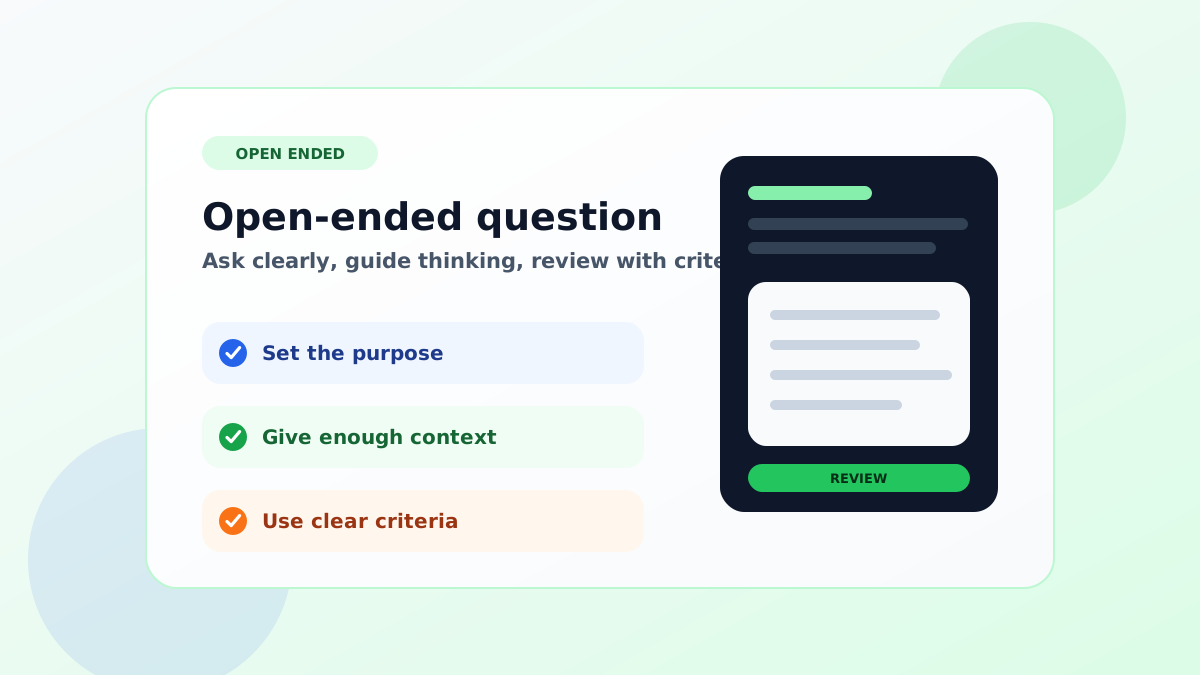
An open-ended question asks learners to build their own answer instead of choosing from prepared options. That makes it useful when you want to see not only what learners know, but how they explain, connect and justify their ideas.
A strong open-ended question is not a vague invitation to write a lot. It has a clear purpose, gives enough direction and makes the expected quality of the answer easier to understand.
1. Decide what you want to see
Before writing the question, decide which thinking skill you want to observe. Should learners explain, compare, justify, give an example, interpret a situation or draw a conclusion?
If this decision is not clear, the question becomes too broad. “What do you think about the topic?” is hard to assess. “Explain two causes of the event and give one short example for each” is much easier to answer and evaluate.
2. Use a clear action verb
Open-ended questions need direction. The prompt should tell learners what to do: explain, compare, justify, support with evidence, give examples, interpret or conclude.
These verbs shape the answer. “Describe” can work, but in many cases a more precise verb leads to better responses.
3. Give the needed context
Think about what learners need before they can answer. If they should respond to a text, image, problem or short scenario, that context needs to be clear.
Too little context leads to guessing. Too much context hides the real task. A short, useful and directly relevant context is usually enough.
4. Clarify the expected scope
Learners often struggle to know how much they should write. Small signals such as “in two sentences”, “give at least one example” or “write three bullet points” make answers more focused.
This is not about limiting thought. It is about making the expectation visible so learners can spend their effort in the right place.
5. Plan the assessment criteria
The hardest part of open-ended questions is assessment. Answers may look different, so you need to know what counts before you start reviewing them.
A simple rubric is often enough: correct use of the concept, a clear reason, a relevant example, clarity of expression and staying on task. These criteria make grading fairer and more consistent.
6. Prepare expected answer points
You do not always need a full model answer, but you should list the main points you expect to see. This helps especially when reviewing many answers.
You can also give learners a small hint. The hint should not give away the answer; it should simply help them start thinking.
7. Preparing open-ended questions in TeinGo
In TeinGo, choose the open-ended question type. Write the prompt, add any context or instruction, and use the explanation area to note the criteria you will use for review.
You can use the question on its own, add it to a quiz, turn it into a worksheet or share it as a PDF. Before publishing, ask one final question: will the learner clearly understand how to answer?
Quick checklist
- Does the question focus on one thinking skill?
- Is the instruction clear?
- Is the needed context included?
- Is the expected scope visible?
- Are the review criteria ready?
- Are the expected answer points clear?
When these pieces are in place, an open-ended question becomes more than a long-answer task. It becomes a practical way to make thinking visible.
Leave a Comment