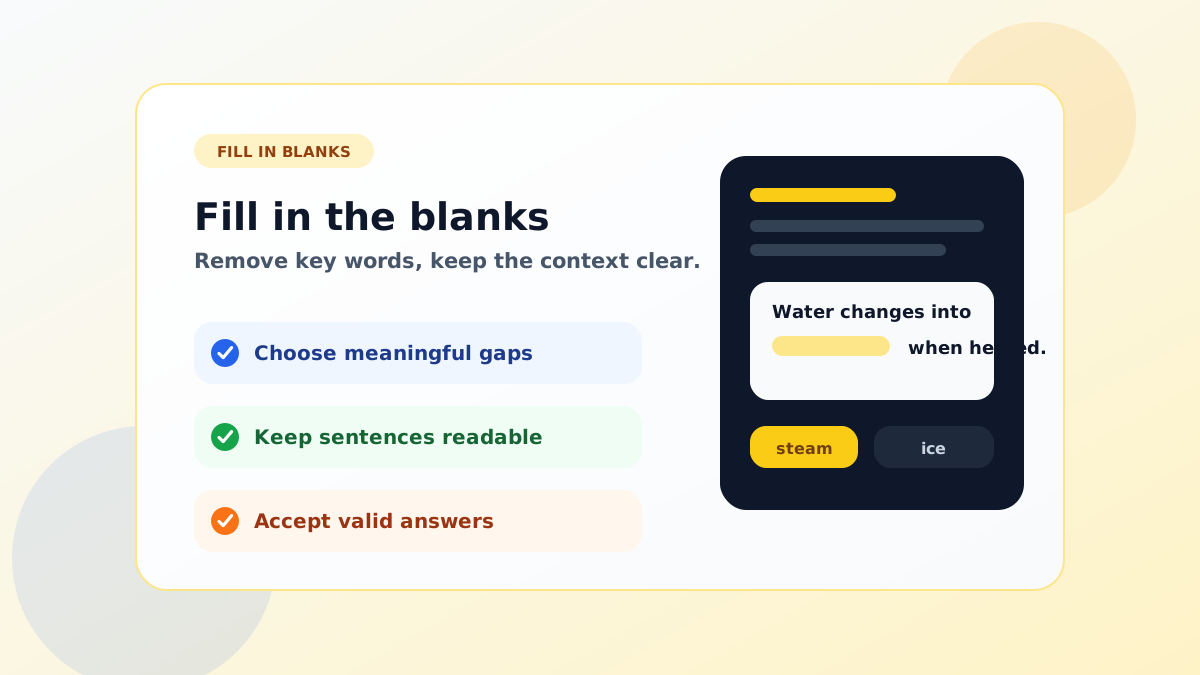
A fill-in-the-blanks activity asks learners to complete a missing word, phrase or part of a sentence. When it is designed well, it checks more than memory. It shows whether learners can read the context and place the right concept where it belongs.
A weak activity removes words at random. Learners may then guess from grammar or write a memorized word without understanding the idea. A strong activity removes the part that matters.
1. Choose the knowledge you want to test
The missing part should carry meaning. A small connector, generic adjective or unimportant word usually does not make a useful blank.
Terms, concepts, process steps, cause-and-effect links and key vocabulary work better because the answer tells you something about the learning outcome.
2. Keep enough context
The words around the blank should help learners think. If you remove too much context, the task becomes guessing. If you leave too many clues, the answer becomes too obvious.
The best balance lets learners use both context and knowledge.
3. Plan accepted answers
Some blanks have one exact answer. Others may allow synonyms, spelling variants or equivalent forms. Decide this before learners answer.
In digital activities, accepted alternatives matter. Capital letters, endings or small spelling differences should not hide correct understanding.
4. Keep the text readable
Too many blanks break the sentence. Even meaningful blanks can make a paragraph hard to follow if they are too close together.
For short items, one or two blanks are usually enough. In longer texts, space them out so the context still works.
5. Use hints and word banks carefully
A word bank can support learners, especially at beginner level. But if the options are too obvious, the activity becomes simple matching.
A useful hint should help learners start thinking without giving away the answer.
6. Add short feedback
After learners answer, showing the correct word is helpful. Explaining why it fits is better.
One clear sentence can point back to the concept, the grammar or the meaning in context. For wrong answers, feedback can show which clue was missed.
7. Preparing fill-in-the-blanks in TeinGo
In TeinGo, choose the fill-in-the-blanks content type. Write the text, mark the missing parts and add the correct answers. If needed, include accepted alternatives and short feedback.
You can use the activity on its own, add it to a quiz, share it as a PDF or publish it as SCORM content for an LMS. Before publishing, ask whether each blank measures something meaningful.
Quick checklist
- Does the blank test important knowledge?
- Is there enough context?
- Are accepted alternatives planned?
- Does the text remain readable?
- Are hints or word banks balanced?
- Does feedback explain the answer?
With these checks, fill-in-the-blanks becomes more than word completion. It becomes a focused way to measure understanding in context.
Leave a Comment