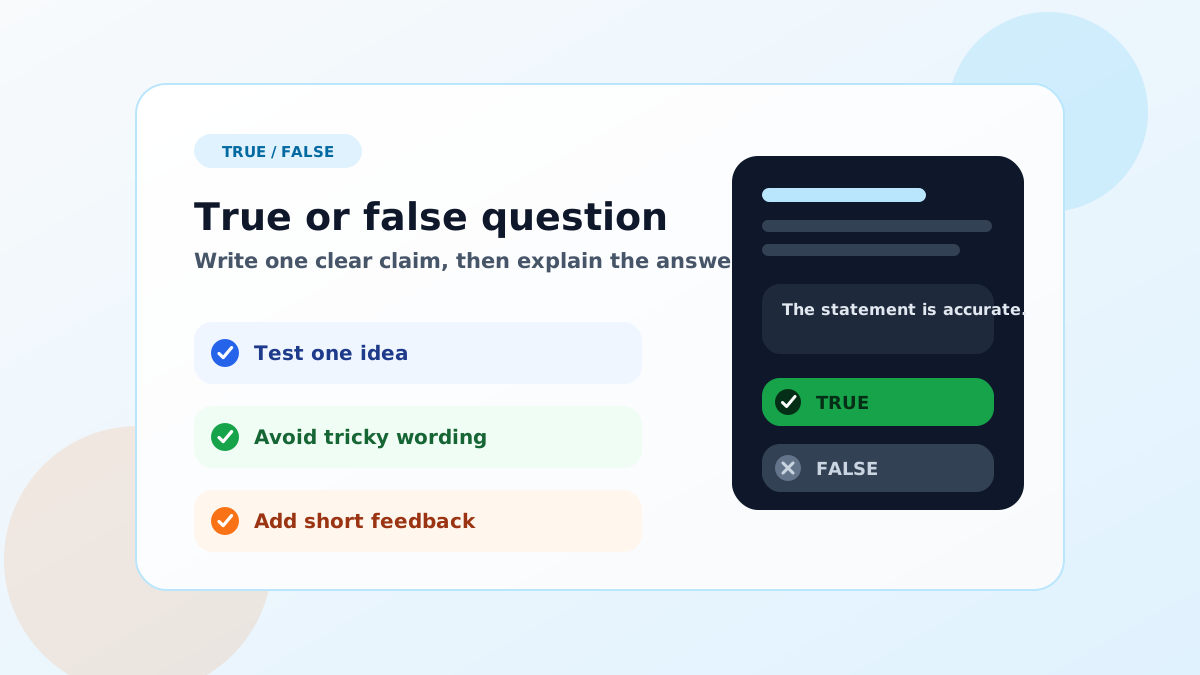
A true or false question asks learners to decide whether a statement is accurate. It is short, quick to answer and useful for checking whether learners can recognize a correct claim or spot a misconception.
Still, a good true or false question is not just a sentence with a random answer. If the wording is loose, learners may guess from clues in the sentence instead of using what they know.
1. Test one idea at a time
The statement should contain one clear claim. When one sentence includes two separate facts, learners may not know which part they are judging.
A cleaner item focuses on a single relationship, definition, rule or condition. That makes the answer easier to defend and the result easier to interpret.
2. Keep the statement clear and direct
True or false items should not depend on complicated wording. The learner should spend effort on the concept, not on decoding the sentence.
Short does not mean shallow. A concise statement can still check a meaningful distinction when it points directly at the learning outcome.
3. Watch absolute words
Words such as “always”, “never”, “only” and “completely” can create unwanted clues. Sometimes they are necessary, but they should be used deliberately.
If learners can answer mainly because the wording sounds too extreme, the question is measuring test-taking strategy more than understanding.
4. Make false statements believable
A false statement should be wrong for a meaningful reason, not because it is obviously absurd. Good false statements often come from common mistakes: swapped terms, missing conditions, reversed cause and effect or overgeneralization.
This helps you see whether learners really understand the concept instead of only rejecting a sentence that looks strange.
5. Balance true and false items
In a set of questions, avoid making nearly everything true or nearly everything false. Learners quickly start looking for patterns.
Also keep statement length and tone balanced. If every correct statement is longer or more formal, the format starts giving away the answer.
6. Add brief feedback
Feedback turns a quick check into a learning moment. After learners answer, they should see why the statement is true or which part makes it false.
One or two sentences are usually enough. The goal is to correct the misconception without turning feedback into a long lesson.
7. Preparing true or false questions in TeinGo
In TeinGo, choose the true or false question type. Write the statement, mark the correct answer and add a short explanation in the feedback area.
You can use the item on its own, add it to a quiz, export it as PDF or publish it as SCORM content for an LMS. Before publishing, check that the statement tests one idea and has one defensible answer.
Quick checklist
- Does the statement test one idea?
- Is the wording clear and direct?
- Are absolute words used carefully?
- Is the false version believable?
- Are true and false items balanced?
- Does feedback explain the answer?
When written this way, a true or false question becomes more than a quick guess. It becomes a compact way to check understanding.
Leave a Comment